
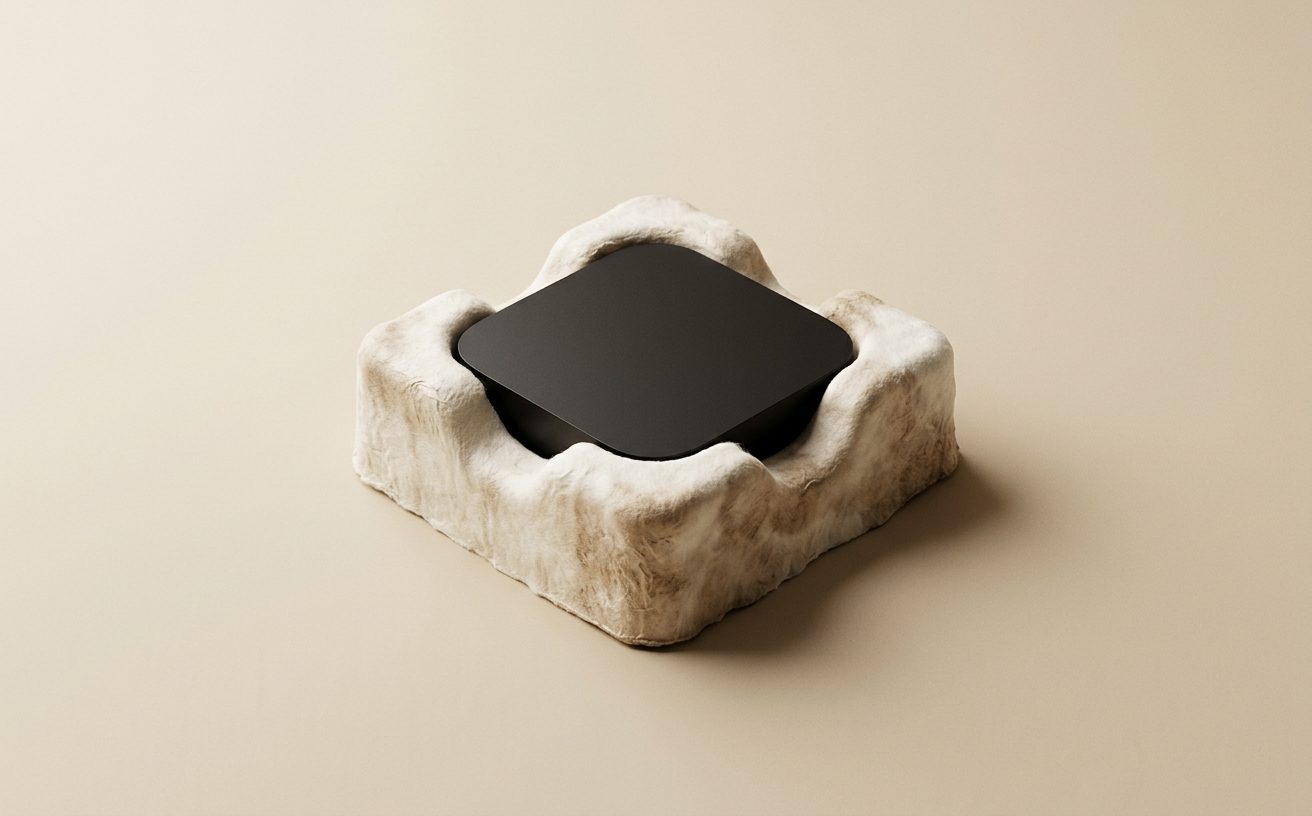
American brands replacing polystyrene foam have a real question to answer. Should mycelium packaging be grown in the US, close to the customer, or bought from a manufacturer that already runs at scale? This post gives an honest answer with public numbers. On electricity the US is close to India. On labour, plant capex and time to scale, it is not.
Key takeaways
- US industrial electricity averaged 9.64 cents per kWh in August 2026, close to the all-in rate in Haryana. Power alone is not the reason to import.
- Production workers in US manufacturing earned an average of $30.21 an hour in September 2026.
- A single new mycelium production line in Europe cost €2.5 million in 2025, before years of process tuning.
- An additional 10% Section 301 duty applies to many Indian goods from 24 July 2026, on top of MFN rates. Check your HS code.
- Suez routing has cut Nhava Sheva to Savannah to about 28 days on some services.
The honest starting point: electricity
The US Energy Information Administration reports an average industrial electricity price of 9.64 cents per kWh in August 2026. It ranges widely: Texas was 7.21 cents, Massachusetts 20.03 and California 24.12 (EIA Electric Power Monthly).
In Haryana, where our plant runs, the HT industrial energy charge is ₹6.95 per kVAh with a fixed demand charge on top, and tariffs are unchanged for 2026-27 (Hindustan Times). All in, industrial users pay about ₹8 to ₹9.5 per unit, roughly 8 to 10 US cents at the RBI reference rate of ₹95.25 per dollar.
So in Texas or the Midwest, power costs about the same as in Faridabad. In California, New England or New York it costs two to three times more. Either way, the bigger gaps are elsewhere.
Labour: where mycelium production gets expensive
Mycelium packaging is grown in moulds. Hand-run plants need people to fill trays, move them through incubation, demould, dry and inspect. The Bureau of Labor Statistics puts average hourly earnings for production and nonsupervisory workers in manufacturing at $30.21 in September 2026 (BLS, Employment Situation table B-8). Benefits and payroll taxes come on top.
In Haryana the statutory minimum wage for unskilled work is ₹585.41 per day from April 2026 (Haryana Labour Department gazette). Skilled operators earn more, but the difference is still large.
Automation: why our cost holds up and quality stays consistent
Low wages do not make good packaging on their own. Most mycelium is still artisanal. Ours is industrial. Dharaksha runs a closed-loop, automated production line in Faridabad, with in-house machines that automate the process from sterilisation to liquid culture inoculation. Each step is instrumented, each batch is reproducible and each SKU has tolerances.
The results are on our homepage: compared with where we started, the line uses 60% less manpower, one third of the energy, and the rejection rate is below 10%, down from 55%. For a US buyer, that means parts that fit your product the same way on every order, and a supplier that is ready to scale when you do.

Substrate: crop residue we buy from farmers
India has around 228.5 million tonnes of surplus agricultural biomass each year (NIBE, National Biomass Atlas of India). We buy crop residue from farmers, which gives them income from their fields’ leftovers. Dharaksha has processed more than 7,000 tonnes of agri-residue to date. A US grower can source corn stover or hemp hurd, but must build its own collection, storage and quality control.

Capex and time to scale
A mycelium plant needs steam sterilisation, clean incubation rooms, tooling, drying and a long ramp to stable yields. For scale, Belgian maker Permafungi invested €2.5 million in one new line in 2025 (Après-demain). Italian biomaterials company SQIM’s €34 million project drew €15 million from the European Investment Bank (EIB). A US build would face similar or higher costs, plus permitting.
Dharaksha’s 27,000 sq ft plant is already running with more than 100 people, and we have just added 8,000 sq ft of assembly space.
USA vs Faridabad cost comparison
| Cost driver | United States | Dharaksha, Faridabad |
|---|---|---|
| Industrial electricity | 9.64¢/kWh average; 24.12¢ in California | about 8 to 10¢/unit all-in |
| Labour | $30.21/hour manufacturing production workers | ₹585/day statutory minimum, automated line |
| Substrate | Collection and storage to build | Surplus residue bought from farmers |
| New capacity | Millions per line, plus ramp-up time | Plant running, assembly expansion done |
| Duty | n/a | MFN plus 10% Section 301 where it applies |
| Sea freight | n/a | about 28 days to Savannah on Suez services |
Tariffs in November 2026: Section 301
From 24 July 2026 the US applies an additional 10% duty on a range of Indian goods under Section 301, on top of normal MFN rates (Federal Register). Whether it applies to your packaging depends on the HS code, so ask your customs broker before you price. Even with the extra duty, the labour and capex gap usually keeps imported packaging competitive.
Lead time and freight carbon, honestly
Lead time. Georgia Ports reports that as carriers return to the Suez Canal, Maersk’s service now takes 28 days from Nhava Sheva to Savannah, 10 to 14 days faster than the Cape route (Georgia Ports Authority). East coast ports such as New York take longer, and West coast buyers should plan for transpacific or rail legs. Share a forecast, hold safety stock, and keep air freight for samples.
Freight carbon. Under GLEC Framework defaults, large container ships emit about 7.6 g CO₂e per tonne-km (EcoFreight summary of GLEC v3.2). For a 20,000 km voyage that is around 0.15 kg CO₂e per kilo of cargo. Mycelium packaging is light, so the ocean leg adds little per pack.

Why US brands work with Dharaksha
- India’s largest mycelium packaging manufacturer, with an automated, scale-ready line.
- Full pack from one supplier: mycelium inserts, inner and outer boxes, honeycomb board and kappa luxury boxes.
- Cold chain: ParaChill ice boxes have a k value of 0.032 W/m·K against 0.0365 for EPS, about 20% longer cold hold.
- Drop tested, with under 1% breakage for glassware and jarred foods.
- Home compostable, a plain alternative to styrofoam.

Frequently asked questions
Usually, yes. US power is similar to India in low cost states, but manufacturing labour averages $30.21 an hour and a new line costs millions. An automated plant in India avoids most of that.
MFN duty applies, and an additional 10% Section 301 duty applies to many Indian goods from 24 July 2026. Check your HS code with a customs broker.
Maersk’s Suez service now runs about 28 days from Nhava Sheva to Savannah. Other ports and carriers take longer.
Yes. It protects fragile goods, our ice boxes insulate better than EPS, and it is home compostable.
Yes. We send free samples for qualified projects.
Related reading
Import costs in other markets
Work with Dharaksha
Get a US quote for mycelium packaging
Send your product, annual volume and US port. We will reply with a free sample plan and a quote from our automated plant in Faridabad.
Leave a Reply