
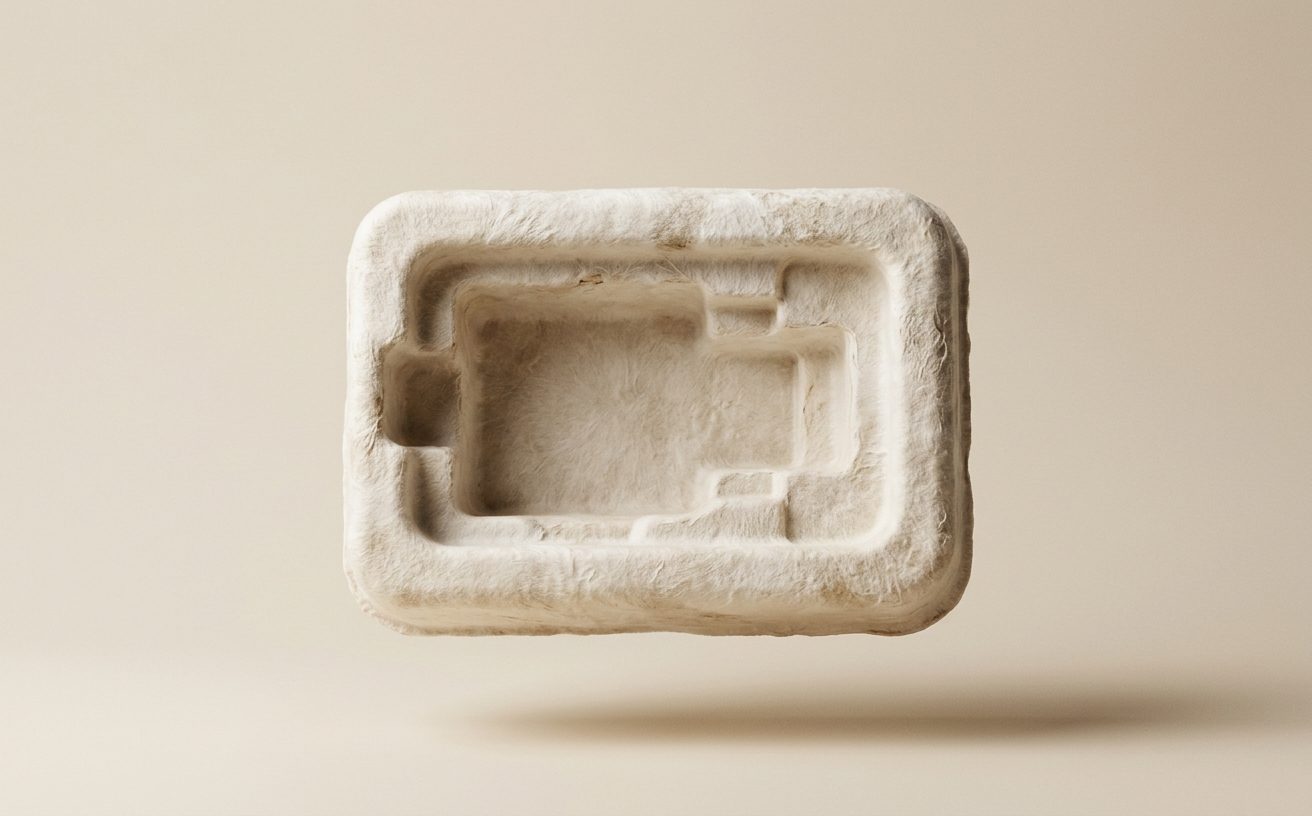
If you sell in Europe and want mycelium packaging, you have two choices. You can make it in Europe, either in your own plant or through a local grower, or you can buy it from a manufacturer that already runs at industrial scale. This post looks at the real cost drivers, with public numbers, and explains why many European buyers now import from Dharaksha in Faridabad, India.
Key takeaways
- EU businesses paid an average of €0.18 per kWh for electricity in H1 2026, about twice the all-in industrial rate in Haryana, where our plant runs.
- Eurostat puts the average EU hourly labour cost at €34.9. Mycelium growing is labour heavy unless it is automated.
- Plant capex is real: a recent Belgian mycelium line cost €2.5 million for a single production line.
- Sea freight to Rotterdam takes about five weeks today, and the freight carbon per kilo of light packaging is small.
- The India-EU FTA was concluded in January 2026 but is not yet in force, so today’s MFN duties still apply.
What drives mycelium packaging cost in Europe
Mycelium packaging is grown, not pressed. Crop residue is chopped, sterilised, inoculated with fungal culture, left to colonise in moulds, then dried. Every step uses either energy or hands. That is why the cost of making it depends so heavily on where you make it.
The four big cost lines are:
- Energy for sterilisation, climate controlled incubation and drying.
- Labour for filling moulds, handling trays and quality checks.
- Substrate, the agricultural residue the fungus grows on.
- Capex and time, the cost of building a clean, controlled plant and getting yields stable.
Europe is expensive on the first, second and fourth, and limited on the third.
Electricity prices: Europe vs India
Eurostat reports that non-household consumers in the EU paid an average of €0.1800 per kWh in the first half of 2026 (500 to 2,000 MWh band, excluding VAT). Ireland was highest at €0.2666 and Italy at €0.2253. Finland was lowest at €0.0928. (Eurostat, electricity price statistics)
In Haryana, the high tension industrial energy charge is ₹6.95 per kVAh at 11 kV, plus a fixed demand charge of ₹290 per kVA per month (The Tribune). The regulator kept tariffs unchanged for 2026-27 (Hindustan Times). With duty, taxes and fuel surcharge, industrial users typically land at ₹8 to ₹9.5 per unit. At the RBI reference rate of ₹106.55 per euro on 30 October 2026, even ₹9.5 is about €0.09 per unit.
That means a European grower pays roughly double for every kWh that goes into steam, incubation rooms and dryers.

Labour costs and why automation matters
Eurostat estimates the average hourly labour cost across the EU economy at €34.9 in 2025, and €40.3 for industry in the euro area (Eurostat news, 31 March 2026). These figures include employer social costs.
In Haryana, the statutory minimum wage for unskilled workers is ₹585.41 per day from 1 April 2026 (Haryana Labour Department gazette). That is not a like for like comparison, and skilled operators earn more. But the gap is more than tenfold.
Cheap labour alone is not the story, though. Most mycelium in the world is still made by hand, tray by tray. Ours is industrial. Dharaksha runs a closed-loop, automated production line in Faridabad, built on in-house machines that automate the process from sterilisation to liquid culture inoculation. Each step is instrumented, each batch is reproducible and each SKU has tolerances. Against where we started, the line uses 60% less manpower and one third of the energy, and the rejection rate has fallen below 10% from 55%.
For a buyer, automation shows up as consistent quality, repeatable fit for your product, and a plant that is ready to scale with your orders. It is also why some European mycelium makers already outsource their large orders to us.
Substrate supply: buying crop residue from farmers
The fungus needs lignocellulosic residue such as straw and husk. India produces a large surplus of it. The National Biomass Atlas estimates about 228.5 million tonnes of surplus agricultural biomass a year (NIBE, National Biomass Atlas of India).
We buy crop residue from farmers, which gives them income from what was left in the field. To date Dharaksha has processed more than 7,000 tonnes of agri-residue. A European plant has to source, store and often transport straw that is also wanted for animal bedding, energy and compost.

Plant capex and time to scale in Europe
Building mycelium capacity is not cheap. In October 2025, Belgian maker Permafungi opened what it called Europe’s largest circular packaging plant, after investing €2.5 million in a new production line in a 1,400 m² site (Après-demain). That is one line, before you count the years of process tuning that get yields and rejection rates under control.
Dharaksha has already spent those years. We run a 27,000 sq ft plant with more than 100 people, and we recently added an 8,000 sq ft assembly area for finished packs.
Cost comparison table: Europe vs Faridabad
| Cost driver | Europe | Dharaksha, Faridabad |
|---|---|---|
| Industrial electricity | €0.18/kWh EU average, H1 2026 | about €0.09/unit all-in |
| Labour | €34.9/hour EU average, 2025 | ₹585/day statutory minimum, automated line |
| Substrate | Competes with bedding and energy uses | 228.5 Mt/yr surplus residue, bought from farmers |
| New capacity | €2.5M for one Belgian line | Plant running, assembly expansion done |
| Sea freight to Rotterdam | n/a | about 36 days median port to port |
Freight carbon and lead time: the honest objections
Freight carbon. The GLEC Framework default for large container ships is about 7.6 g CO₂e per tonne-km (EcoFreight summary of GLEC v3.2). Take a voyage of 20,000 km, roughly the Cape route to Rotterdam: that is about 0.15 kg CO₂e per kilo of cargo. Mycelium packaging is light, so the sea leg adds very little per pack. Trucking straw and running fossil-heavy power in Europe can add more than the ship does.
Lead time. This one is real. Container schedules from Nhava Sheva to Rotterdam show a median of about 36 days, with the fastest carrier around 30 days (SchedulesMCP lane data). Red Sea routing changes can move that. The fix is planning: share a forecast, hold safety stock in Europe, and use air only for samples or urgent top-ups.

Duties and the India-EU FTA in November 2026
The EU and India concluded their free trade agreement on 27 January 2026. The Commission sent it to the Council for signature in September 2026, but it is not yet in force (European Commission). Until it is, standard EU MFN duties apply. The rate depends on how your customs broker classifies the product, so check the HS code before you price.
On compliance, our packaging is PPWR compliant, with documents available on request, and it is home compostable. Read our PPWR packaging compliance guide for the detail.
Why EU buyers choose Dharaksha
- India’s largest mycelium packaging manufacturer, with an automated, scale-ready line.
- One supplier for the whole pack: mycelium inserts, outer boxes, honeycomb board and kappa luxury boxes.
- Cold chain too: ParaChill ice boxes have a thermal conductivity of 0.032 W/m·K against 0.0365 for EPS, holding cold about 20% longer.
- Proven with brands such as Dabur. See our customers.

Frequently asked questions
For most brands, yes. EU electricity averaged €0.18/kWh in H1 2026, about double the all-in industrial rate in Haryana, and EU labour costs average €34.9 an hour. Add plant capex and you need very high volumes before local production pays off.
Current schedules from Nhava Sheva to Rotterdam show a median of about 36 days port to port. Plan with a forecast and safety stock in Europe.
Not yet. The agreement was concluded in January 2026 but is not in force as of November 2026, so MFN duties apply today. Check your HS code with a customs broker.
Yes. Our packaging is PPWR compliant and home compostable, and we share compliance documents on request.
Yes. We send a free sample for qualified projects. Contact us with your product dimensions.
Related reading
Import costs in other markets
Work with Dharaksha
Get a European quote for mycelium packaging
Send us your product, volumes and destination port. We will reply with a free sample plan and a quote from our automated plant in Faridabad.
Leave a Reply