
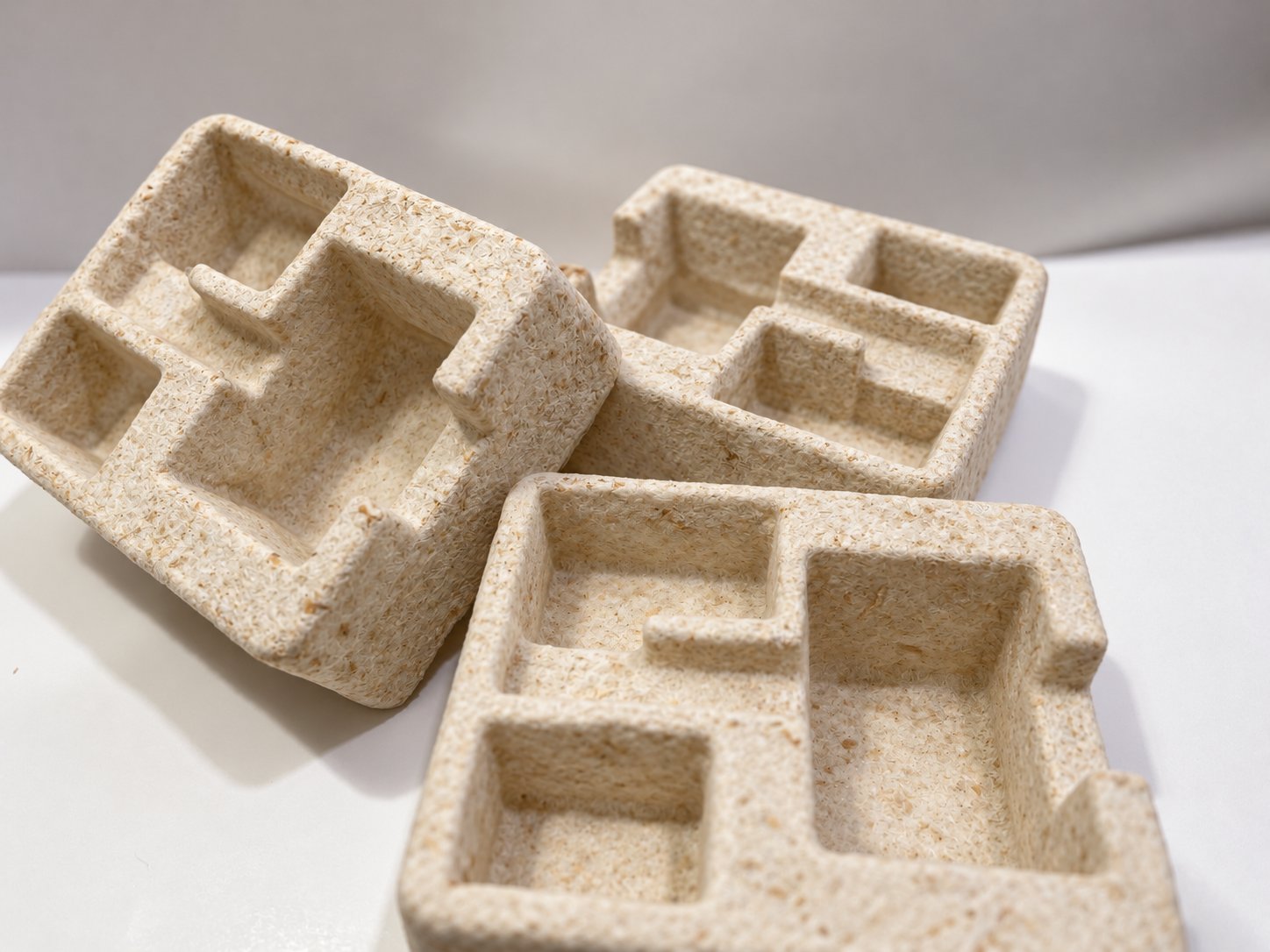
Australia wants polystyrene out of consumer packaging, and brands need a compostable replacement that protects products just as well. Mycelium packaging fits. The open question is where to make it. This post sets out the cost drivers with public data and explains why Australian buyers can import mycelium packaging from Dharaksha in India for less than it costs to grow it locally.
Key takeaways
- APCO set a target to phase out moulded consumer EPS by July 2025. That target will not be fully met, so demand for EPS replacements is still building.
- Australia’s National Minimum Wage is A$26.44 an hour from 1 July 2026, and award wages rose 4.75%.
- Under ECTA, 100% of Australian tariff lines are now duty free for qualifying Indian goods.
- Sea freight from Nhava Sheva to Melbourne takes around 18 days.
- Dharaksha’s automated line delivers consistent, scale-ready supply without you building a plant.
Why Australia needs EPS alternatives now
The Australian Packaging Covenant Organisation set a national target to phase out problematic and unnecessary plastics, including expanded polystyrene in consumer packaging, by July 2025. APCO now says the targets will not be fully met and a revised timeline is coming (APCO, National Packaging Targets). Some states have moved on their own, such as Western Australia’s ban on expanded plastic packaging from 1 July 2025.
For brands, that means pressure to switch is real, but local supply of compostable protective packaging is thin.
Labour costs: Australia vs India
From 1 July 2026, Australia’s National Minimum Wage is A$26.44 an hour, and minimum award wages rose by 4.75% (Fair Work Ombudsman). Superannuation and on-costs sit on top, and most factory roles pay above the minimum.
In Haryana, the statutory minimum wage for unskilled workers is ₹585.41 per day from April 2026 (Haryana Labour Department gazette). That is about A$1.10 an hour on an eight hour day. Skilled operators earn more, but the gap is more than twentyfold.
Mycelium packaging is labour hungry when made by hand: filling moulds, moving trays through incubation, demoulding and drying. In Australia, every manual step is costly.
Automation: how Dharaksha keeps quality consistent
Most mycelium is still artisanal. Ours is industrial. Dharaksha runs a closed-loop, automated production line in Faridabad. Our in-house machines automate everything from sterilisation to liquid culture inoculation. Each step is instrumented, each batch is reproducible and each SKU has tolerances.
On our homepage we share the results against where we started: 60% less manpower, one third of the energy, and a rejection rate below 10%, down from 55%. For an Australian buyer, automation means repeatable fit and finish, consistent protection in transit and a line that is ready to scale with demand.

Energy for sterilisation and incubation
Growing mycelium uses energy for steam sterilisation, warm incubation rooms and drying. Australian business electricity prices vary by state, network and retail contract, and we could not find a reliable published average for industrial users in 2026, so we have not put a number on it here. Your own bill is the best benchmark.
For comparison, Haryana’s HT industrial energy charge is ₹6.95 per kVAh, unchanged for 2026-27 (Hindustan Times). All in, industrial users typically pay ₹8 to ₹9.5 per unit, or roughly 12 to 14 Australian cents. Our line also uses one third of the energy it once did.
Substrate: crop residue we buy from farmers
Mycelium grows on agricultural residue such as straw and husk. India has an estimated 228.5 million tonnes of surplus agricultural biomass every year (NIBE, National Biomass Atlas of India). We buy crop residue from farmers, which adds to their income. Dharaksha has processed more than 7,000 tonnes of agri-residue so far.

Capex and time to scale
A mycelium plant is a biotech facility: sterilisers, clean incubation rooms, moulds, dryers and months of tuning before yields settle. For a sense of cost, Belgian maker Permafungi invested €2.5 million in one new production line in 2025 (Après-demain). Australian construction and labour costs would push a local build higher, and the ramp-up takes time you may not have.
Dharaksha already runs a 27,000 sq ft plant with more than 100 people and has added 8,000 sq ft of assembly space.
Australia vs Faridabad cost comparison
| Cost driver | Australia | Dharaksha, Faridabad |
|---|---|---|
| Minimum wage | A$26.44/hour from July 2026 | ₹585/day statutory minimum, automated line |
| Industrial electricity | Varies by state and contract | about 12 to 14 Australian cents/unit all-in |
| Substrate | Collection and storage to build | Surplus residue bought from farmers |
| New capacity | Plant build and ramp-up needed | Plant running, assembly expansion done |
| Import duty | n/a | Duty free under ECTA for qualifying goods |
| Sea freight | n/a | about 18 days to Melbourne |
ECTA: duty free entry for Indian goods
The Australia-India Economic Cooperation and Trade Agreement entered into force on 29 December 2022. Australia’s final tariff cuts took effect on 1 January 2026, and DFAT says 100% of Australian imports from India are now permitted to enter duty free (DFAT, Using ECTA). Goods must meet ECTA rules of origin, so ask your broker to confirm the HS code and paperwork.
Lead time and freight carbon, honestly
Lead time. Australia is close to India by sea. Carrier schedules show about 18 days from Nhava Sheva to Melbourne and about 20 days to Sydney (Cogoport schedules). Add time for production, customs and trucking, and plan with a forecast and some local stock.
Freight carbon. GLEC Framework defaults put large container ships at about 7.6 g CO₂e per tonne-km (EcoFreight summary of GLEC v3.2). For a voyage of around 10,000 km that is roughly 0.08 kg CO₂e per kilo of cargo, small for light packaging.

What Australian brands get from Dharaksha
- India’s largest mycelium packaging manufacturer, on an automated, scale-ready line.
- Every layer of the pack: mycelium inserts, inner and outer boxes, honeycomb board and kappa luxury boxes.
- Cold chain: ParaChill ice boxes with a k value of 0.032 W/m·K against 0.0365 for EPS, about 20% longer cold hold. Useful for seafood, meal kits and pharma.
- Home compostable, so it fits Australia’s push away from EPS.
- Free samples for qualified projects.

Frequently asked questions
Yes. Dharaksha ships mycelium packaging to Australia from its automated plant in Faridabad, India. Inserts, ice boxes and outer boxes can come in one shipment.
For most brands, yes. Australia’s minimum wage is A$26.44 an hour, a new plant costs millions, and ECTA lets qualifying Indian goods in duty free.
Carrier schedules show about 18 days from Nhava Sheva to Melbourne and about 20 days to Sydney, port to port.
Yes. It protects fragile goods, our ice boxes insulate better than EPS, and it is home compostable.
DFAT says 100% of Australian imports from India can now enter duty free under ECTA, if the goods meet rules of origin. Confirm your HS code with a broker.
Related reading
Import costs in other markets
Work with Dharaksha
Get an Australian quote for mycelium packaging
Send your product, volumes and Australian port. We will reply with a free sample plan and a quote from our automated plant in Faridabad.
Leave a Reply