
“Compostable” is one of the most powerful words a beauty brand can print on a box, and one of the most misunderstood. Customers want to know that the packaging will truly disappear after use, not linger for years in a landfill. This guide explains what compostable cosmetic packaging really means, how it differs from “biodegradable”, and how to choose materials that keep both your products and your promises intact.
Key takeaways
- Biodegradable means a material is broken down by microorganisms over time. Compostable means it breaks down within a set period under composting conditions, into compost with no harmful residue.
- Home compostable materials break down in a garden compost bin. Industrially compostable ones need the heat of a commercial facility.
- Plant-based, plastic-free materials such as mycelium, paper and moulded pulp are the simplest route to a compostable pack.
- Compostable plastics are regulated in India and need certification and labelling under the Plastic Waste Management Rules.
Biodegradable vs compostable: the difference that matters
What is eco-friendly packaging? In simple terms, it is packaging that does less harm across its life, from the raw material to what happens after use. Within that broad idea, two words are often used interchangeably:
- Biodegradable: a material can be broken down by bacteria, fungi and other microorganisms. On its own, the word says nothing about how long that takes or where.
- Compostable: a material breaks down within a defined time under composting conditions, turning into water, carbon dioxide and biomass (compost) without leaving toxic residue or visible fragments.
So all compostable materials are biodegradable, but not all biodegradable materials are compostable. For a beauty brand, “compostable” is the stronger and clearer promise, as long as you can back it up.
Home compostable vs industrially compostable
This is the detail most packs leave out, and the one customers care about most.
| Type | Where it breaks down | Typical examples | What to tell customers |
|---|---|---|---|
| Home compostable | Garden compost bin or soil at ambient temperature | Mycelium, uncoated paper and board, moulded pulp, cotton | “Break it up and add it to your compost or garden soil.” |
| Industrially compostable | Commercial composting facility at high temperature | Many PLA and other compostable plastics | “Compost only where an industrial facility accepts it.” |
| Recyclable, not compostable | Paper or plastic recycling stream | Laminated board, PET, PP, glass | “Recycle with paper, plastic or glass.” |
In India, very few cities collect packaging for industrial composting, so home compostable materials are the most practical choice for a pack that really gets composted.
Standards and Indian rules to know
- IS/ISO 17088 is the Indian standard used to specify compostable plastics.
- EN 13432 is the common European standard for industrially compostable packaging, and home composting certifications such as “OK compost HOME” are widely recognised.
- Under the Plastic Waste Management (Amendment) Rules, 2024, items made from compostable or biodegradable plastics must carry the required marking and labelling, and their makers need a certificate from the Central Pollution Control Board before selling them.
The simplest way to avoid this complexity is to use materials that are not plastic in the first place. Mycelium, paper and moulded pulp are plant-based, so the compostability story is easy to explain and easy for customers to act on.

Which parts of a cosmetic pack can be compostable?
A typical skincare or makeup pack has several components. Here is what can realistically be compostable today.
Inserts and trays
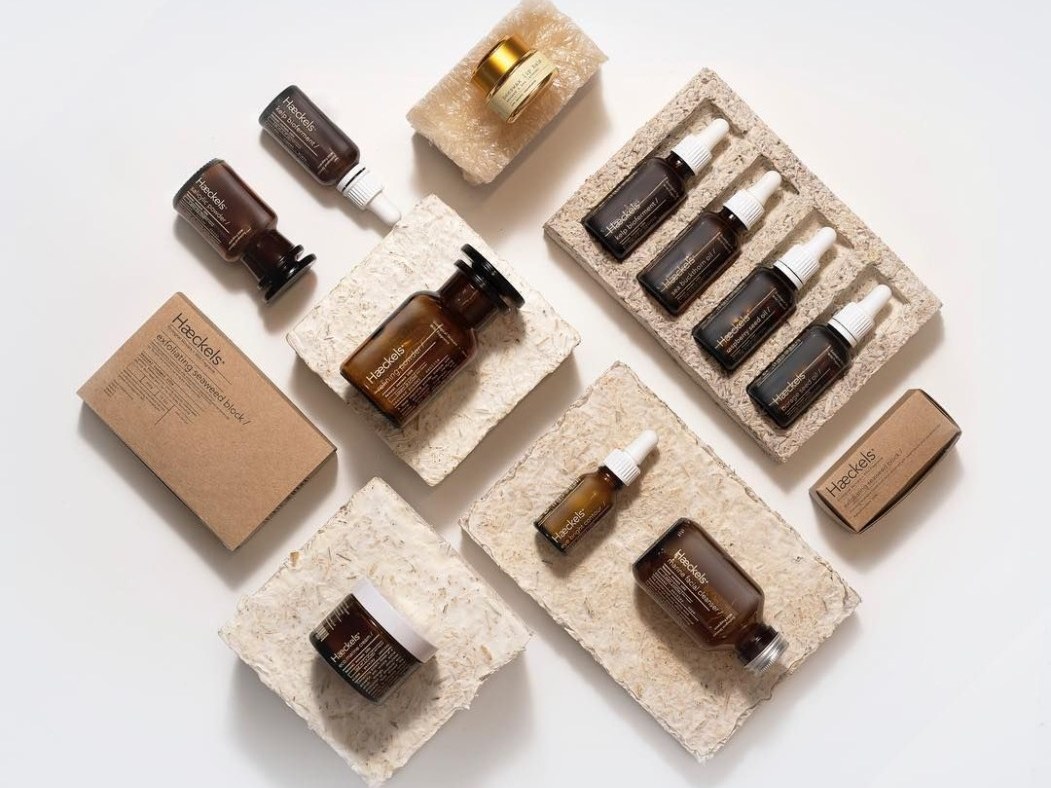
Inserts are the easiest win. Moulded mycelium trays hold serums, jars and compacts in individual cavities, protect them in transit and can be composted at home. Moulded pulp is another option for simpler shapes.
Cartons and gift boxes
Paperboard cartons and rigid boxes are compostable when they avoid plastic lamination, metallised films and PVC windows. Use water-based coatings and paper-friendly inks, and keep foil to small details.
Pouches and wraps
Paper, glassine and cotton work for wraps and bags. Compostable films exist, but check certification and remember the industrial composting caveat.
Primary containers
The bottle, jar or tube touches the formula, so it has to meet product safety and stability needs first. Glass and aluminium are durable and recyclable, and they pair perfectly with a compostable secondary pack. It is better to be clear about what is compostable than to stretch the claim.

How to make compostable claims customers trust
- Be specific. Say “This tray is home compostable” rather than “eco friendly packaging”.
- Separate the parts. A small icon guide on the box, such as “Tray: compost”, “Box: recycle with paper”, “Bottle: recycle with glass”, helps customers do the right thing.
- Keep proof ready. Hold test reports, certificates or material declarations from your supplier.
- Avoid vague imagery. Leaves and green colours are lovely, but they are not a claim. Let the material speak for itself.
Cost and performance: what to expect
Compostable materials perform well when they are matched to the job. A mycelium insert gives about 3× the shock absorption of EPS at equivalent density, is water-resistant and is drop-tested for the product it holds. Unit costs depend on shape and volume, and they are often balanced by fewer breakages, smaller shipping boxes and less loose filler. A pack that customers photograph and share also brings marketing value that a foam tray never will.
A quick checklist before you print “compostable”
Before the artwork goes to print, run through these five checks with your packaging team:
- List every component of the pack, down to the tape, label and ribbon.
- Mark each one as home compostable, industrially compostable or recyclable.
- Confirm the claim with a test report, certificate or material declaration from the supplier.
- Write disposal instructions in plain English, for example “Break up the tray and add it to your compost”.
- Test the complete pack for drops and humidity so the compostable parts still protect the product through the monsoon.
Where Dharaksha fits
Dharaksha Ecosolutions is India’s largest mycelium packaging manufacturer, based in Faridabad. We grow cosmetic inserts and trays from agricultural residue, pair them with paper-based retail boxes and corrugated shippers, and drop-test the whole pack. Explore our luxury packaging for beauty brands, see the full eco friendly packaging range, or read our guide to biodegradable perfume packaging.
Frequently asked questions
It is packaging for beauty and skincare products that breaks down under composting conditions into compost, without toxic residue. Mycelium inserts, uncoated paperboard and moulded pulp are common examples.
No. Biodegradable only means microorganisms can break a material down over time. Compostable means it breaks down within a set period under composting conditions and leaves no harmful residue.
Yes. Mycelium is plant-based and plastic-free. Customers can break the insert into pieces and add it to a home compost bin or garden soil.
Yes. Under the Plastic Waste Management (Amendment) Rules, 2024, commodities made from compostable or biodegradable plastics need marking and labelling and a certificate from the Central Pollution Control Board.
Eco friendly packaging is packaging made and disposed of with less harm to the environment, for example plant-based, plastic-free materials that can be composted or recycled after use.
Related reading
Work with Dharaksha
Want a cosmetic pack you can honestly call compostable?
Send us your product range and we will suggest a mycelium insert and paper box combination, drop-test it and send a free sample. Call or WhatsApp +91 92173 09172, or use our contact page.
Leave a Reply